
PCIe Support in the Unified Communication X Framework - UCX
Unified Communication X (UCX) is a communication framework for modern high-performance network fabrics. The purpose of UCX is to provide a set of abstract communication primitives, masking the low-level details while maintaining high performance and scalability, across multiple different networking technologies.
Dolphin is in the process of developing our own transport for UCX, integrating support for Dolphin’s PCI Express® networking as part of the UCX framework. This allows existing applications to utilize the ultra-low latency and high bandwidth enabled by Dolphin’s NTB products through UCX libraries and software API.
Dolphin's UCX transport implementation is open source and hosted on our public GitHub organization page. Our long-term goal is to contribute this transport upstream to the UCX community, and to continue to develop and improve it.
Supported Operations
UCX provides a unified software interface for multiple networking technologies, focusing on point-to-point communication and implementing best practices for message transfers of all sizes. UCX aims to utilize the best of available hardware resources, hardware offloading, and optimized network data movement. This includes RDMA, shared memory (such as RMA put/get), tag-matched send/receive, active messages, data streams, remote atomic operations, etc.
UCX is supported by most modern implementations of Message Passing Interface (MPI), including OpenMPI, MPICH, and MVAPICH2. The UCX community also provides its own companion libraries and frameworks, such as Unified Collective Communications (UCC). Popular frameworks like Nvidia Collective Communications (NCCL) and TensorFlow support UCX natively. The rich ecosystem built on top of UCX provides high-level communication functionality and network collectives commonly used in HPC and AI/ML workloads.
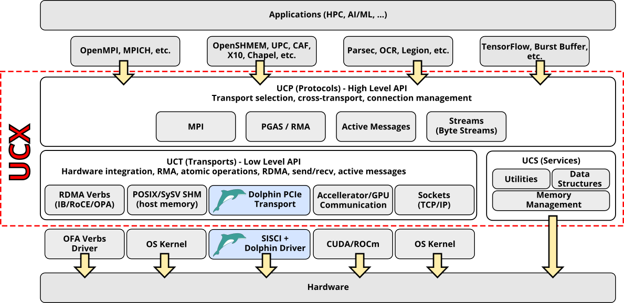
The components are, as follows:
- UCX protocols (UCP): High-level abstractions such as tag-matching, streams, session and connection handling, selecting optimal transport mechanism
- UCX transports (UCT): Low-level communication primitives, such as active messages, remote memory access and atomic operations
- UCX services and memory management (UCS): Intercepts memory allocation and release events, used to manage and register memory used by the transport
Dolphin UCX transport is currently under development. The implementation extends UCT with corresponding memory registration in UCS, primarily with support for RMA-based get/put operations and active messages over a PCIe network. It also supports inline short messages and bulk transfer using zero-copy message transfer (zcopy and bcopy). We are currently in the process of performance tuning, optimizing large message transfers and improving the performance for large-sized zcopy and bcopy transfers with hardware accelerated zero-copy DMA available in Dolphin NTB adapter cards. Support for transferring directly to GPU memory, using CUDA/GPUDirect for Nvidia GPUs and ROCm for AMD GPUs, is on the roadmap for future versions.
Please contact Dolphin for further information.
UCX over PCI Express® Performance Benefits
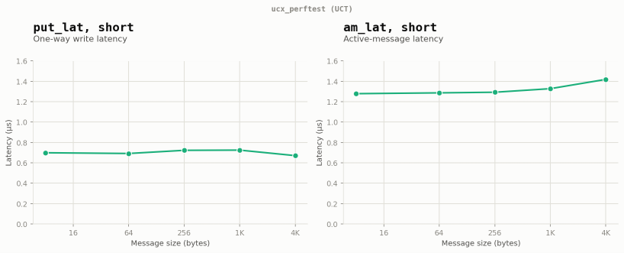
By utilizing PCI Express® networking, Dolphin’s UCX transport provides unrivaled ultra-low latency message transfers for UCX. Dolphin’s implementation allows the CPU to write messages directly to remote memory, enabling inline and zero-overhead message transfer in the sub-microsecond range. Depicted below is message latency with two AMD EPYC 9015 machines connected back-to-back using Dolphin’s MXH570 PCIe 5.0 adapter cards:
References and Links
- Our work in progress implementation: https://github.com/DolphinICS/ucx
- The UCX project web site: https://openucx.org/
- The UCX project Source https://github.com/openucx/ucx
- UCX documentation: https://openucx.readthedocs.io/en/master/running.html
For more information about the low-level Dolphin SISCI shared memory API used to implement our PCIe-based UCX transport, see our page on Dolphin SISCI Developer’s Kit. For accelerating network communication for existing application software, see also our page on Dolphin SuperSockets and TCP/IP over PCIe (IPoPCIe).